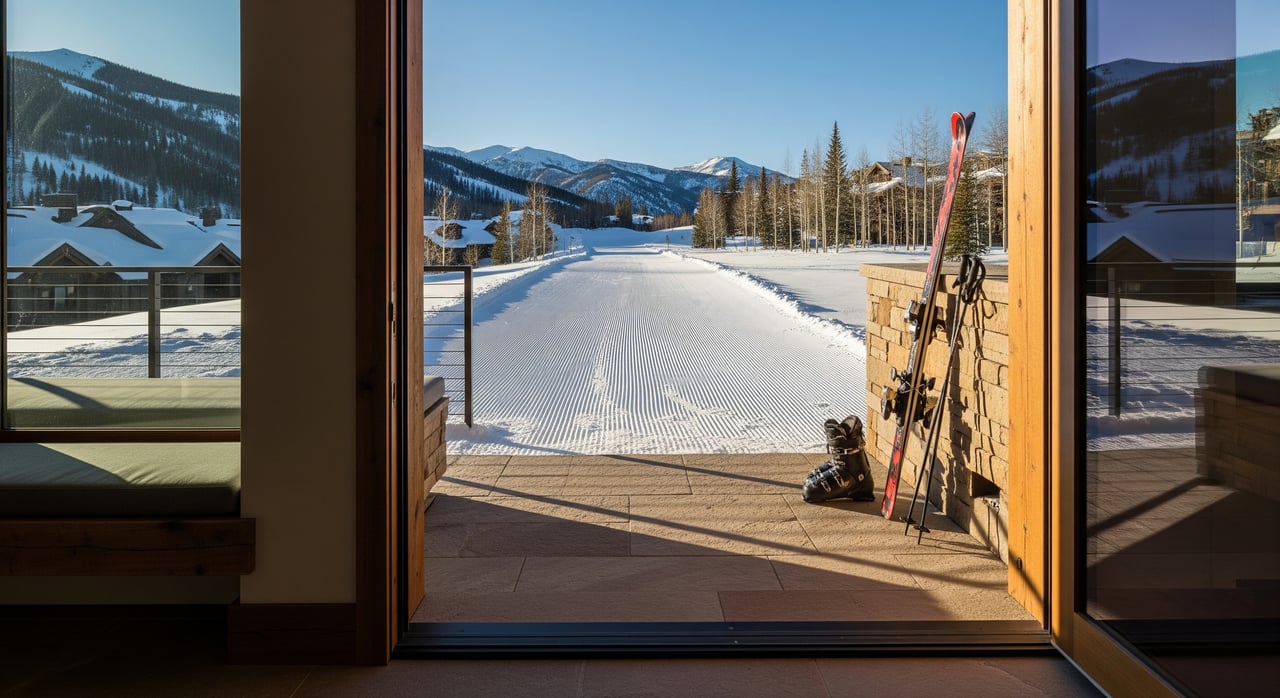
If you are shopping for a second home in Snowmass Village, you have likely seen the phrase “ski-in/ski-out” used in many ways. It sounds simple, but the reality can range from true ski-to-door convenience to a short walk or a shuttle ride. You want clarity so you can pay for the access that actually fits your lifestyle. In this guide, you’ll learn what ski-in/ski-out really means, how access differs across Snowmass, how it affects value and rentals, and the exact questions to ask before you buy. Let’s dive in.
What ski-in/ski-out means
True ski-in/ski-out
A property is true ski-in/ski-out when you can step out your door, click in, and glide directly onto maintained resort terrain or a lift without a car, shuttle, or long walk. A short bootpack or simple traverse can still qualify. You may hear this described as “ski to the door” or “ski to the lobby.”
Common variations you’ll see
- Slope-adjacent or slope-side: The building or lot touches a run or easement, but you may walk a few yards to reach groomed snow.
- Ski-access or short walk: You carry skis across a cleared path or paved walkway, often 100 to 500 feet.
- Near-access or walkable to lifts: An easy walk, generally up to about a quarter to half a mile, but not slope-direct.
- Shuttle-served: Access relies on a scheduled or on-demand shuttle provided by a building, HOA, or municipality.
Marketing vs. reality
Listing language is often optimistic. Ask for specifics: the exact route, whether it is an official groomed trail or an informal connector, and how that route performs in low-snow or early and late season. Confirm whether the route sits inside resort boundaries or crosses private property with HOA rules that could limit how you or guests use it.
Snowmass Village access patterns
Resort layout and homes
Snowmass Village spans base areas, on-mountain neighborhoods, and more dispersed residential pockets. Access depends on micro-location. Base-area condos and on-mountain clusters tend to offer the most direct connections, while mid-village and peripheral areas may rely on a short walk or shuttle.
Shuttles and transit
Snowmass Village operates a free local shuttle, and regional transit links the area to Aspen and nearby communities. These services help if you are not slope-side. They reduce friction, but the experience differs from gliding straight from your door to a run.
Terrain and seasonality
The quality of your daily route depends on the type of terrain you use and its grooming or snowmaking. Wide cruisers near base areas are often the simplest. Steeper catwalks or mid-mountain connectors might feel more technical. During low-snow windows or shoulder seasons, some slope-adjacent connections may involve extra walking or a shuttle.
Property types you’ll see
- Base-area condos and hotels: Often marketed as ski-to-lobby or immediate access.
- On-mountain single-family and townhomes: May have private ski trails or easements that tie directly into runs.
- Mid-village and peripheral neighborhoods: Commonly “steps to shuttle” or “short walk,” with sidewalks and snow removal maintained by HOAs or the municipality.
How access affects value
Price and resale
Slope-direct properties typically command a premium over similar homes that require a walk or shuttle. The exact premium in Snowmass varies with building quality, views, rental history, and the scarcity of true slope-side options. To price precisely, you will need local comps and a broker’s analysis for the specific building or neighborhood.
Income and ongoing costs
If short-term rental income matters to you, properties with immediate access often achieve higher nightly rates and stronger occupancy. Operating costs can also be higher. On-mountain and base-area buildings may have elevated HOA dues for amenities, snow management, or on-site services, and insurance and taxes often reflect mountain replacement costs and location.
Lifestyle tradeoffs
With true ski-in/ski-out, you save time every day. There is no parking, no driving, and fewer logistics for multi-generation groups and guests. The flip side is that depending on the exact location, you may still need to descend to base areas for dining and shops, and the vibe near lifts can feel lively.
Noise, parking, and privacy
Slope-adjacent buildings close to lifts can see more foot and skier traffic, which some buyers enjoy and others avoid. Parking can be more limited, and deliveries and guest drop-off may be more dependent on village systems. Decide whether you prioritize energy and easy access or greater privacy and quiet.
Due diligence checklist
Route and terrain specifics
- Request a labeled trail map showing the precise route from the front door to the nearest lift.
- Identify the difficulty rating of required runs or catwalks, and consider who will use them, including newer skiers and children.
- Ask about grooming and snowmaking on the route and how often it has been interrupted in recent winters.
- Get actual distance and vertical data for both skiing and walking segments.
Legal and HOA considerations
- Verify recorded easements or deed language that support skier access, and who controls that corridor.
- Confirm whether the route is inside resort boundaries, which usually simplifies maintenance.
- Review HOA rules related to trail use, guest access, after-hours policies, and any rental restrictions.
Operations and finance
Break down HOA fees and what they cover, such as private trail grooming, shuttles, building services, and snow removal.
Discuss insurance for on-slope locations and whether special assessments fund mountain infrastructure.
If rental income matters, request historical performance and confirm current rental rules.
Safety and emergency access
- Ask local authorities about avalanche mitigation or zoning that may affect the property.
- Confirm winter emergency vehicle access, and whether any closures or evacuations have occurred historically.
Questions to ask directly
- “Precisely how do guests reach the lift in normal and low-snow conditions?”
- “Who maintains the connector route, and how often?”
- “Have there been recorded closures of the route, and why?”
- “Does the HOA have documented easements or resort agreements for direct access?”
- “What are the shuttle times, stop locations, and seasonal changes?”
Decide what fits your lifestyle
Start with how you ski. If you want to click in on your deck and lap runs between video calls, seek true ski-to-door with documented routes and grooming. If you love the village scene and do not mind a quick walk, a slope-adjacent or shuttle-served option can offer excellent value. For many second-home buyers, the highest return is the daily convenience you and your guests actually use.
If you want help mapping routes, comparing HOAs, and validating easements before you bid, connect with Zach Lentz for a private, data-forward strategy.
FAQs
What does “true ski-in/ski-out” mean in Snowmass?
- It means a direct, continuous skiable connection from your property onto maintained resort terrain or a lift, without relying on a car, shuttle, or long walk.
How reliable is ski access early or late season?
- Reliability depends on grooming and snowmaking on your specific route; some connectors work all season while others may require walking or a shuttle during low-snow periods.
Do slope-side homes always rent for more?
- Many achieve higher rates and occupancy due to convenience, but actual uplift varies by unit size, amenities, and local rental rules, so verify performance before you buy.
What HOA details should I review for ski access?
- Look for recorded easements, trail maintenance obligations, shuttle policies, rental rules, snow removal standards, parking, and guest drop-off procedures.
How can I confirm a listing’s ski route is legitimate?
- Request a trail map with the exact route, ask who maintains it and how often, confirm boundary status, and review easement documents to verify legal and practical access.